How Fast Does PAD Progress What The Timeline Actually Looks Like
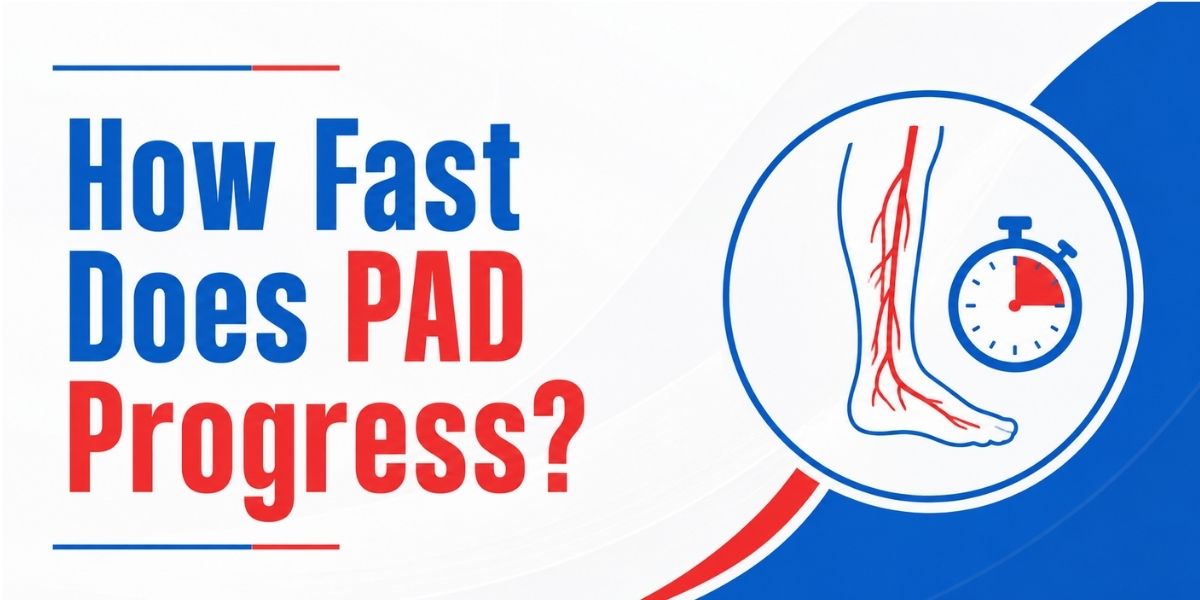
Slowly for most people, and then suddenly for a few. That inconsistency is exactly what makes the question so difficult to answer in a single sentence. Peripheral artery disease is a plaque-driven condition that builds over decades, and the majority of patients stay stable for years with sensible medical care. A minority move from mild narrowing to a threatened limb within twelve to twenty-four months. Which group you land in is decided far more by your risk factors and how early PAD is caught than by luck.
The Four Stages And How Long Each Lasts
Doctors describe this condition in four recognized steps. Knowing the stages of PAD progression helps you place yourself on the map, though a realistic PAD progression timeline varies enormously from person to person.
Stage One Silent Narrowing
Plaque is accumulating but blood flow remains sufficient at rest and during light activity. There are no PAD symptoms whatsoever. This stage commonly lasts ten to twenty years and is where the disease is easiest to control and most frequently missed. Roughly half of all patients are sitting here right now without knowing it.
Stage Two Pain With Walking
Calf, thigh, or buttock pain appears after a predictable walking distance and stops within minutes of resting. This is called intermittent claudication and it is where most people finally seek help. Left alone, this stage often remains stable for years. About one in four patients worsen over five years, which means three in four do not. Supervised walking and risk-factor control keep the PAD symptoms from advancing in the large majority.
Stage Three Pain At Rest
Pain now appears while lying down, particularly at night, and eases when the leg hangs over the bed. This marks a genuine shift. PAD disease at this point is described as critical limb-threatening ischemia, and the window for acting is measured in weeks rather than years. Restoring flow with an interventional PAD treatment becomes the priority.
Stage Four Tissue Damage
Ulcers that will not heal, blackened skin, or gangrene. Without revascularization, amputation risk within a year is substantial. Reaching this stage almost always means earlier warning signs went unaddressed, which is the strongest argument for identifying PAD long before it gets here.
What Speeds It Up And What Slows It Down
Progression is not fixed. The same patient can be on two very different trajectories depending on what happens after diagnosis.
These accelerate PAD:
These slow it down measurably:
Patients who commit to the second list frequently hold steady for a decade or longer, and many report that peripheral artery disease affects their daily life less at year five than it did at diagnosis.
How Progression Is Actually Measured
Guesswork is not a monitoring plan. Your specialist tracks a small number of objective markers over time:
Tracking these turns peripheral artery disease from something that feels unpredictable into something measurable. It also tells your team precisely when conservative care has stopped being enough and a PAD treatment procedure is warranted.
Frequently Asked Questions
How fast does peripheral artery disease progress in a typical patient?
Most people move slowly. Around 20 to 25 percent with claudication see meaningful worsening across five years, and roughly 1 to 2 percent progress to critical limb ischemia annually. Those numbers shift sharply in the wrong direction for smokers and people with poorly controlled diabetes.
How quickly does PAD get worse if I keep smoking?
Considerably faster. Smokers develop symptoms about a decade earlier on average, progress to advanced disease more often, and have markedly higher rates of bypass failure and amputation. Quitting produces measurable improvement within months.
Can PAD disease ever stop getting worse?
Yes. Plaque already formed will not vanish, but progression can be halted for years with medication, exercise, and risk-factor control. Many patients remain in the same stage for the rest of their lives.
What are the earliest signs to watch for?
Leg fatigue on hills or stairs, one foot that runs colder, toenails growing slowly, hair thinning on the shins, and cuts that take weeks to close. These quiet PAD symptoms appear long before pain does, and noticing them is how early PAD gets caught.
How often should I be rechecked?
Annually for most patients, more often if your numbers are moving or symptoms change. Advanced Medical Group builds the interval into your care plan rather than leaving it to you to remember.
Getting An Accurate Picture Of Your Own Timeline
Averages describe populations, not people. The only way to know your trajectory is to measure it, then measure it again a year later. If you have leg pain when walking, a foot that feels cold, or two or more risk factors for peripheral artery disease, an ankle-brachial index test takes minutes and costs very little.
Our vascular specialists diagnose and manage PAD across four Hudson County locations: Jersey City, Union City, West New York, and North Bergen, with Saturday appointments and free insurance coverage checks. Call Advanced Medical Group at (201) 581-6120 or book online, and let Advanced Medical Group replace the guesswork with a number you can track.