Laser Ablation
Needle-free laser treatment for fine spider veins and facial vessels — no injections, no needles, no downtime.
What Is Laser Ablation?
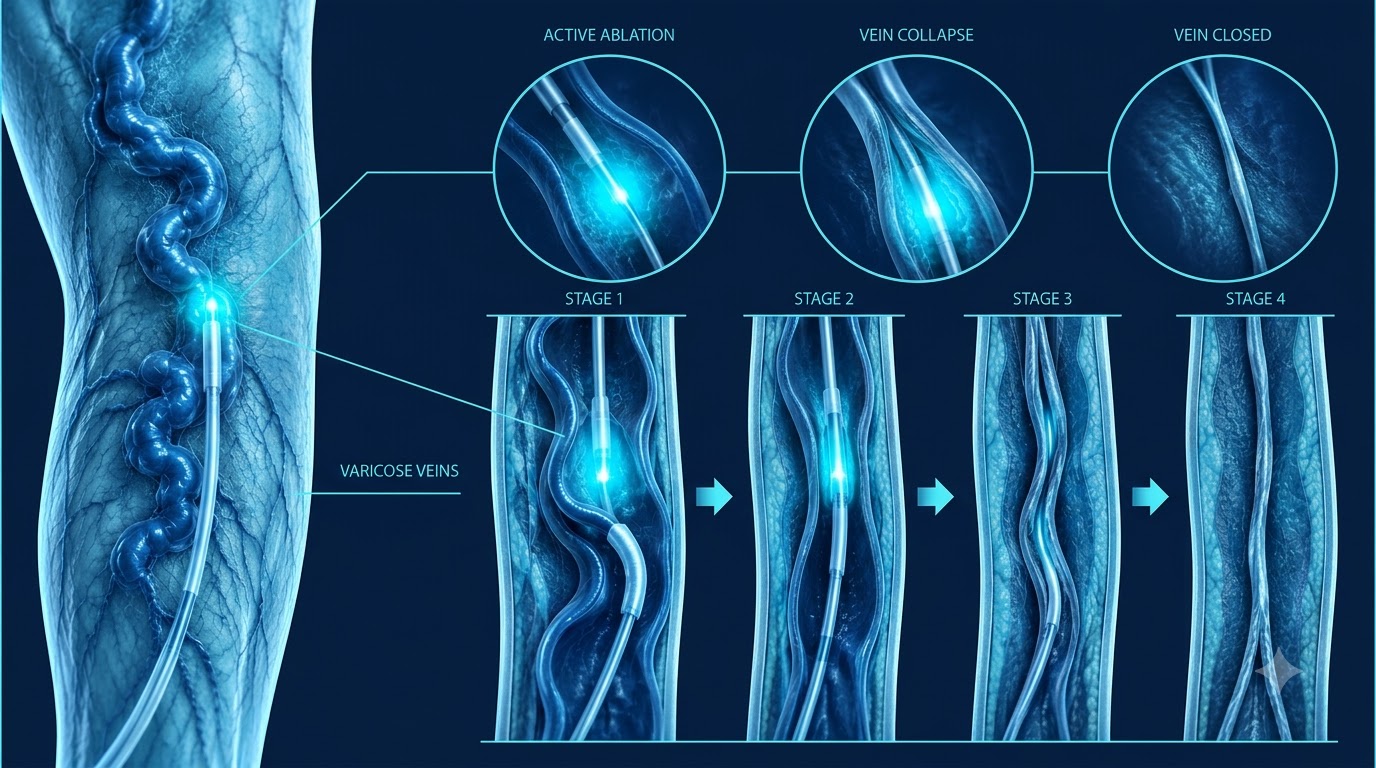
Laser ablation uses focused laser energy delivered through the skin to collapse and permanently eliminate spider veins and fine surface vessels — with no needles, no injections and no incisions. The laser targets the hemoglobin (the red pigment) inside the blood vessel, generating precise heat that damages the vein wall from the outside in, causing it to collapse, seal shut and be gradually absorbed by the body.
It is the treatment of choice for very fine spider veins, facial veins and patients who prefer a completely needle-free approach. The laser wavelength is chosen to be absorbed by the red hemoglobin inside the target vein — passing harmlessly through the overlying skin and selectively destroying only the vessel (a principle called selective photothermolysis). Available across all AMG locations — Jersey City · North Bergen · Union City · West New York.
Key Facts
Veins Treated with Laser Ablation
Fine Spider Veins
Very small red, pink or purple vessels (under 1mm) on the legs and ankles — particularly those too fine or too superficial for needle injection with sclerotherapy. Laser reaches these vessels without physical contact.
Facial Veins & Redness
Small vessels on the face — around the nose, cheeks and chin — where injection is not appropriate. Laser ablation is the preferred treatment for facial telangiectasias and rosacea-associated redness.
Residual Veins Post-Sclerotherapy
Some spider veins do not fully respond to sclerotherapy or remain visible after multiple sessions. Laser ablation effectively eliminates these residual vessels in a follow-up treatment.
Cherry Angiomas
Small bright red benign vascular growths on the skin surface — easily and permanently eliminated with targeted laser energy in a single short session.
Rosacea-Associated Redness
Diffuse facial redness and fine visible vessels associated with rosacea can be significantly reduced with a course of laser ablation sessions targeting the superficial vessel network.
Needle-Averse Patients
For patients with needle phobia or a strong preference for a non-injection approach, laser ablation achieves excellent results on suitable veins without any needles, injections or skin puncture.
Treatment — Step by Step
Consultation & Vein Assessment
Provider assesses the target veins — size, depth, color and location — to confirm suitability. Skin tone is also assessed, as laser settings are calibrated to each patient's complexion for safety and results.
Skin Prepared
The treatment area is cleaned. Protective eyewear is provided to patient and provider. A cooling gel may be applied to improve comfort and protect the skin surface.
Laser Delivered to Skin
The laser handpiece is placed gently against the skin and short, precise pulses of focused energy are delivered to each target vein. No needles, no injections — the laser passes harmlessly through the skin.
Heat Seals the Vein
The energy is absorbed by the hemoglobin inside the vessel and converts to heat, damaging the inner vein wall and causing it to collapse and seal shut. Adjacent healthy tissue is unaffected.
Walk Out & Veins Fade
No bandaging or compression is needed in most cases. Slight redness settles within hours. The body absorbs the sealed vessel over 4–6 weeks, with additional sessions until the desired result is achieved.
Recovery & Aftercare
Laser ablation has minimal recovery — but protecting the treated skin from sun and heat is essential for the best results.
Sun Protection — Essential
The most critical aftercare instruction for laser treatment. Sun exposure on treated skin causes temporary hyperpigmentation (darkening) that can take months to resolve. Avoid for 4–6 weeks.
- Direct sunlight on treated areas
- Sunbathing, beach or tanning beds
- Fake tan or self-tanning products on treated area
- Apply SPF 30+ daily to all treated areas
- Wear UV-protective clothing when outdoors
Skin Care
Treat the treated area gently for the first week:
- Hot baths, saunas or steam rooms for 48 hours
- Harsh scrubs or exfoliants on treated skin
- Perfumed creams or alcohol-based products on treated area
- Cool or lukewarm showers from day one
- Gentle fragrance-free moisturiser to soothe treated skin
Activity & Exercise
Unlike sclerotherapy, most normal activities can resume immediately after laser ablation:
- Return to work and daily activities immediately
- Light exercise resumed from the next day
- Intense heat-based exercise (hot yoga) for 48 hours
- Swimming for 24 hours after treatment
Before You Come In
A little preparation helps you get the best, safest result.
- Arrive with clean skin — no lotion, makeup or self-tan on the area
- Avoid sun and tanning for a couple of weeks beforehand
- Wear loose clothing over the treatment area
- Tell your provider about any recent skincare or medications
Recovery Timeline
Mild redness & slight swelling
Mild redness and slight swelling around the treated veins — normal and expected. Some veins may look slightly darker before they begin to fade.
Redness settles, veins start fading
Redness resolves. Treated veins may stay visible for a few weeks but begin to fade as the body absorbs them.
Veins fade significantly
Veins fade significantly. A follow-up session is booked if further treatment of remaining veins is needed.
Full results visible
Final results are visible. A final provider assessment confirms clearance and discusses any remaining veins.
Frequently Asked Questions
Most patients describe a mild snapping or stinging sensation with each laser pulse — similar to a light rubber band snap against the skin. The sensation is brief and a cooling gel helps minimize discomfort. No anesthesia is required.
Neither is universally superior — they are complementary. Sclerotherapy (Asclera) is more effective for most spider veins on the legs and covers more area per session. Laser is preferred for very fine veins, facial vessels and needle-averse patients. Many patients benefit from a combination of both.
Most patients achieve satisfactory results in 1–3 sessions spaced 6–8 weeks apart. The number depends on the density, size and location of the veins being treated.
Temporary redness, mild swelling and slight darkening of treated veins are normal in the days after treatment and resolve on their own. Blistering or skin changes are rare when appropriate settings and sun protection guidelines are followed.
Laser ablation is most effective on lighter to medium skin tones. Your provider assesses your skin tone at consultation and adjusts settings accordingly. For darker skin tones, sclerotherapy is often the safer and more effective choice.
Yes — we provide care in English and Spanish at all locations. Se habla español.
Ready to take the next step?
Schedule a consultation at our North Bergen Vascular Procedure Center. Same-day appointments available.