
Genicular Artery Embolization (GAE)
Non-surgical knee pain relief — right in our office.
What Is Genicular Artery Embolization?
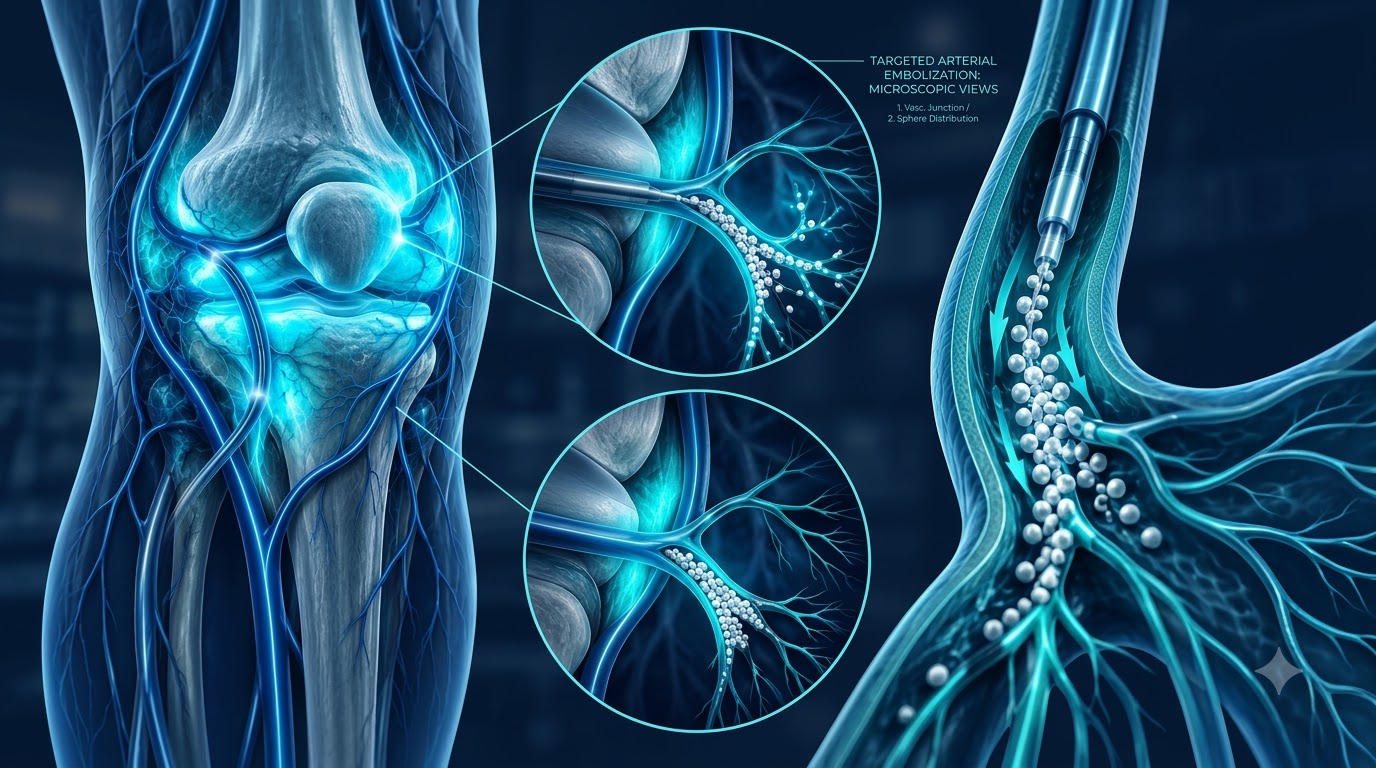
Genicular Artery Embolization (GAE) is a minimally invasive, image-guided procedure used to treat chronic knee pain caused by osteoarthritis. It works by reducing blood flow to the inflamed synovial tissue lining the knee joint — the tissue responsible for generating pain signals.
Tiny microspheres are delivered through a small catheter directly into the genicular arteries supplying the inflamed tissue. This reduces inflammation and pain — without surgery, without cutting the knee, and without a hospital stay. Performed entirely in our private North Bergen Vascular Procedure Center.
Key Facts
The Condition GAE Treats: Knee Osteoarthritis
A Leading Cause of Knee Pain
Knee osteoarthritis is one of the most common causes of chronic knee pain, affecting millions of adults — particularly those over 50.
Cartilage Wears Down
It occurs when the cartilage cushioning the knee joint gradually wears down, causing bones to rub together and triggering persistent inflammation in the surrounding synovial tissue.
A Non-Surgical Alternative
Traditional treatments provide only temporary relief and many patients are told their only option is knee replacement surgery. GAE offers a non-surgical alternative that treats the root cause.
Symptoms

Pain with Movement
Knee pain when walking, climbing stairs or rising from a chair.

Swelling & Warmth
Visible swelling and warmth around the knee joint from ongoing inflammation.

Stiffness
Difficulty bending or straightening the knee — especially in the morning or after sitting.
Pain at Rest
Aching or throbbing pain even when resting or at night.

Reduced Range of Motion
Inability to fully bend or extend the knee, limiting daily activities.

Reduced Quality of Life
Avoiding activities, difficulty sleeping and loss of independence due to chronic knee pain.
How GAE Works
Catheter Inserted
A tiny catheter is inserted through a small nick in the skin — usually at the wrist or groin — and guided to the knee's genicular arteries using real-time X-ray imaging.
Arteries Mapped
Contrast dye is injected to create a detailed map of the genicular arteries, identifying the specific vessels feeding the inflamed synovial tissue.
Microspheres Injected
Tiny embolic particles (microspheres) are injected into the target arteries — reducing blood flow to the inflamed tissue and interrupting the inflammation cycle.
Pain Reduces
With reduced blood supply to the inflamed synovial tissue, inflammation decreases significantly — leading to lasting pain relief over the following weeks.
Am I a Candidate for GAE?
Good Candidates
- Moderate to severe knee pain from confirmed osteoarthritis
- Failed conservative treatments — PT, injections or medications not providing lasting relief
- Want to avoid or delay total knee replacement surgery
- Not a surgical candidate due to age, health conditions or other factors
- Osteoarthritis confirmed on X-ray or MRI
Not Recommended If
- Knee pain from a cause other than osteoarthritis
- Allergy to contrast dye or iodine
- Severe kidney impairment
- Pregnancy
- Uncorrectable blood clotting disorder
What to Expect at Our Vascular Procedure Center
Confirm candidacy
Dr. Richard reviews your knee imaging, symptoms and history to confirm osteoarthritis and GAE candidacy.
Labs & preparation
Routine labs and imaging to prepare. Local anesthesia only — no need to fast unless instructed.
45–60 minutes in-office
45–60 minutes in our Vascular Procedure Center. Catheter guided to knee arteries under X-ray. Microspheres delivered. No incision or stitches.
Home within 1–2 hours
Short monitored rest in office. Most patients go home within 1–2 hours. Mild soreness normal for 2–3 days.
Relief in 2–4 weeks
Pain relief begins within 2–4 weeks. Follow-up with Dr. Richard to monitor progress.
Frequently Asked Questions
Clinical studies show 70–80% of patients experience significant pain reduction. Many report improved mobility within 4–6 weeks.
Most patients experience relief lasting one to two years or more. GAE can be repeated if symptoms return and does not preclude knee replacement if needed.
Coverage varies by plan. Our team verifies your coverage before your visit at no cost. Medicare and many commercial plans increasingly cover GAE.
Performed under local anesthesia — most patients feel only mild pressure. Soreness is normal for 2–3 days and managed with over-the-counter pain relief.
Yes — both knees can be treated in the same session or separate visits.
Cortisone reduces inflammation temporarily. GAE addresses the underlying blood supply driving the inflammation for longer-lasting relief.
No. GAE is outpatient — performed in our private In-Office Vascular Procedure Center. Most patients go home within 1–2 hours.
Yes — we provide care in English and Spanish. Se habla español.
Ready to take the next step?
Schedule a consultation at our North Bergen Vascular Procedure Center. Same-day appointments available.